

The Conversation

Your Hosts

Two perspectives, one table, and a lot of questions worth asking.

Robin Heaston
Host

Robin Heaston

I'm Robin Heaston. I live in Columbia, South Carolina, and I run Heaston Innovations, an agency that builds websites, CRMs, and AI tools for small businesses. I have also been a realtor for a little over two years. Between the two, I have spent a lot of time watching how people actually make decisions, not how they are supposed to on paper, and that is most of what I bring to this show.

The rest of my time goes into Heaston Innovations. I founded it and I still run it. It's an agency built around one plain problem: most small businesses have no idea whether people can actually find them anymore, whether that's a regular search, an AI answer, or someone asking their phone a question out loud. We build the websites, the AI tools, and the automation that sits underneath all of that, so the answer to "can people find you" is yes instead of a shrug.

I also host another show, Anything & Nothing Podcast. And when none of that is happening, I'm probably on a golf course, playing worse than I'd like to admit.

Here's the thing about Dewey or Don't We. Dr. Fisher spent his life inside philosophy, real academic work, decades of it, in rooms most people never walk into. I didn't. What I bring to the table is everyday life: work, money, technology, relationships, whatever people are actually dealing with on a Tuesday. He hands me the big idea. I drag it down to ground level and ask what it means for somebody running a business, raising a kid, or trying to figure out whether the AI thing is worth the hype or just the noise.

That gap between us isn't a flaw in the show. It's the whole point. If two people who already think alike sit down and talk, all you get is an echo. Put a philosopher who has spent decades on the meaning of an idea across the table from a guy who sells houses and builds AI tools for a living, and you get something worth actually listening to.

I'm not here to win the argument, and I'm not here to prove I know more than Doc. I don't, not in his lane, and I wouldn't try. What I'm here for is to keep asking the question everyone listening is asking themselves: okay, but what do I actually do with that?

At the end of the day, that's the job. Take the idea Dr. Fisher brings, make it useful, and hand it back to whoever's listening.
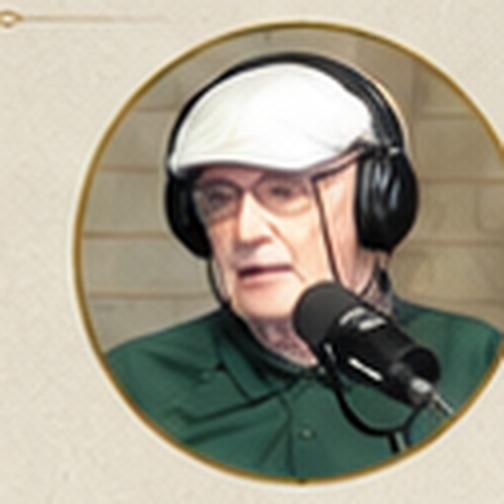
Dr. James Fisher
Co-Host

Dr. James Fisher

My name is James E. Fisher. I hold an Ed.D in History and Philosophy of Education (a Doctorate in History and Philosophy of Education) from Indiana University (1971). I am President of Philosophy of Educology Research Initiative/USA (PERI/USA), (in 2025 reestablished from being President of Educology Research Associates/USA (ERA/USA)) am retired since 1964 and am known as "Doc" in podcast episodes produced and hosted by Rob Heaston, Owner of Heaston Innovations.

Since 1971, I have been working in Philosophy of Educology, first from the standpoint of Analytical Philosophy of Educology (within the Linguistic Turn in Western Philosophy), then from the standpoint of Phenomenological Philosophy of Educology (within the Consciousness Turn in Western Philosophy), and now from the standpoint of Experiential Philosophy of Educology (within the Experiential Turn in Western Philosophy).

My work in Experiential Philosophy of Educology is within the context of Big History, from the standpoint of John Dewey's 20th century philosophy of pragmatism, a philosophy of pragmatism, within the Experiential Turn in Western Philosophy, that has experience as its selectively focused upon subject-matter, and is work assisted in by the practice of Analytical Philosophy of Educology.

My publications, from that standpoint, have been principally in The International Journal of Educology, which I co-published with James E. Christensen (Ph.D. in Comparative Education), and which is out of publication now and, also, on the Educology Research Associates/USA (ERA/USA) website, which no longer exists.

Publications with Christensen (who works in Analytical Philosophy of Educology) can be accessed at "my publications | James E Christensen", which features: Christensen, James E and Fisher, James E (1979): Analytic Philosophy of Education as a Subdiscipline of Educology. Washington, DC: University Press of America. ISBN 0819108022 and Christensen, James E and Fisher, James E (1983): Organization and Colleges of Education: An Educological Perspective. Sydney: Educology Research Associates. ISBN 0949784028.

In Pedagogika, Vytautas Magnus University (Vytauto Didziojo universitetas) in Kaunas, Lithuania, which is still in print, I published in 2001, a paper titled A Brief History of the Development of the Meaning, Reference, and Significance of 'Educology'.

About the Dynamic

Doc Fisher spent a career studying how people learn and why, more than fifty years of it. I spent mine building businesses, selling houses, and lately building things with AI. He shows up with the framework and the long view. I show up asking whether it survives contact with a Monday morning.

That is the whole show. He starts from the philosophy, I start from what happens when you try it, and we work toward each other until one of us gives. Sometimes it is me. Sometimes he changes his mind on air, which is rarer than you would think for a man with a doctorate. We do not agree on everything, and when we drift into politics or the future of work it gets loud. That is fine. Nobody here is trying to win. We are trying to get it right.

Random topic, one hour, no script. Practical philosophy is what happens when a thinker and a builder refuse to talk past each other.